The Mirror World
Living with 7 vampiresThe Mirror World is an adjacent supernatural realm linked to the ordinary world by a gate-like passage through mirrors. It transforms a familiar household object into a threshold of captivity and danger: entry is physically possible, but return is uncertain, and the realm is inhabited by beings capable of taking over vampire bodies. For Y/N, it is not merely a strange landscape but the setting in which identity, freedom, bodily safety, and the reliability of appearances are repeatedly put at risk.
Definition and Access
The Mirror World is first explained as another world near the one inhabited by Y/N and the vampires. J-Hope describes its inhabitants as beings resembling the vampires who cannot ordinarily pass through the gate and therefore sometimes take over the vampires' bodies while their hosts sleep. This explanation establishes the realm as both neighboring and inaccessible: it is close enough to affect the ordinary world, yet separated by a barrier that forces its inhabitants to seek another route.
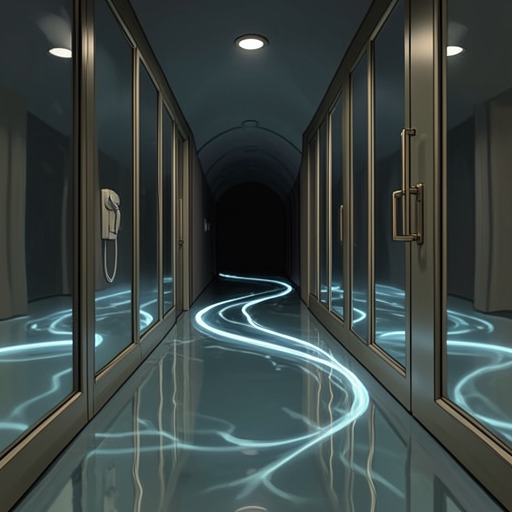
That route is the mirror. When Jin's body suddenly falls to the ground while a shadow remains standing and holding Y/N's wrist, the shadow pulls Y/N inside the mirror. The surface feels like water, making the transition less like walking through a doorway than being drawn through a liquid membrane. Y/N is consequently placed inside the mirror itself, where the household object becomes a portal and the boundary between worlds becomes physically permeable.
Landscape and Threats
The realm initially presents itself with startling beauty. After Y/N is thrown outside a bubble and welcomed into a supposed new world, a giant bird carries Y/N through the unfamiliar space. The bird does not attend to Y/N and continues flying toward its destination, but its movement gives Y/N a broad view of the surroundings. The sight is so beautiful that Y/N has never seen a place like it before. This beauty creates an important contrast with the realm's violence: the landscape invites wonder even while its inhabitants make it unsafe.
The danger is not limited to the green-eyed beings. While trying to survive there, Y/N feels a sharp pain in the leg and discovers an enormous water snake or similar creature. The attack turns the beautiful environment into an active physical threat. Later, when Jin finds the same cave in which the bird had landed, he warns Y/N that a small exit requires swimming and specifically cautions against the water snake. The cave therefore becomes both a recognizable landmark and a trap-like route toward escape, linking Y/N's first disorientation to the rescue attempt.
Captivity, Rescue, and Conflict
The Mirror World functions as a place of forced displacement. Y/N is not shown choosing to enter it; the shadow's grip and the mirror's watery surface make the passage an act of abduction. Once inside, Y/N struggles without success and is presented to the captor outside the bubble. The welcome to a new world is therefore coercive rather than hospitable. The language of arrival conceals an immediate loss of agency, turning exploration into imprisonment.
Jin later enters the realm and reaches the cave where Y/N had been taken. His route through a waterfall and across the giant cave leads to a possible exit, but the journey requires cooperation and exposes both travelers to the water snake. The rescue is thus organized around recovered knowledge: Y/N's experience identifies the cave, while Jin's movement through it supplies a practical route toward the boundary between worlds.
The realm also becomes the source of a wider conflict involving the vampires. Because its inhabitants cannot simply cross the gate, they use body possession to exert influence beyond their own world. The Mirror World consequently threatens not only travelers who enter it but also the social and bodily integrity of the vampires in the ordinary world. Later, when the group considers dividing its forces to confront the beings who took Y/N, the possibility that those opponents can divide themselves as well shows that the conflict is not governed by ordinary physical assumptions.
Knowledge, Recognition, and Return
Y/N's memories of the realm become actionable evidence. When J-Hope asks where the captors took Y/N, Y/N points toward two mountains and identifies them as the likely destination. The Mirror World is therefore gradually converted from an incomprehensible place into a map of remembered features: mountains, the cave, the waterfall, the water, and the dangerous snake. Memory does not erase the realm's mystery, but it allows the people outside it to formulate a rescue plan.
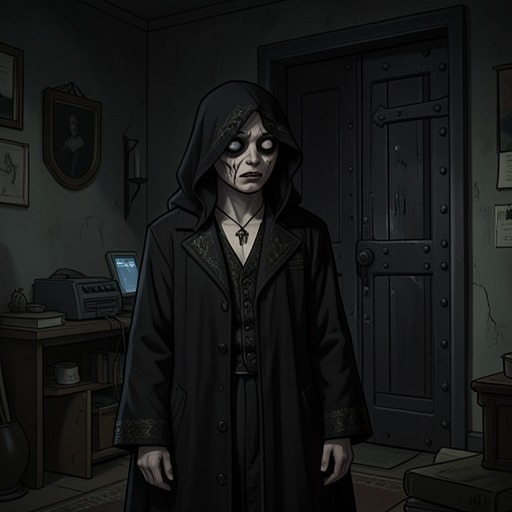
Its most consequential feature is the instability of identity. Green-eyed beings are associated with bodies that may not belong to them, while appearances can conceal who is present. This makes the realm's influence persist even after a character seems to have returned or resumed a familiar form. The danger is consequently epistemic as well as physical: characters must determine whether a face, body, or apparent ally can be trusted.
Narrative Significance
The Mirror World enlarges the story's central conflict from a struggle against individual predators into a contest over thresholds and possession. Y/N's abandonment by a mother who drives away, the earlier experience of being attacked and having blood taken, and the later passage through the mirror all place bodily vulnerability beside failures of protection. In the Mirror World, that pattern becomes literalized: a person can be separated from safety, carried into an unknown environment, and treated as an object by forces that control the route between worlds.
The location's beauty and hostility also embody the story's recurring contrast between appearance and truth. The mirror looks ordinary until it feels like water; the new world appears beautiful before its creatures and terrain reveal their danger; a familiar body may conceal a green-eyed intruder. The Mirror World therefore serves as the narrative's most direct image of unstable reality. It is a place where escape depends on recognizing concealed structures, remembering exact landmarks, and refusing to treat an apparently beautiful or familiar surface as proof of safety.